Digital Marketing
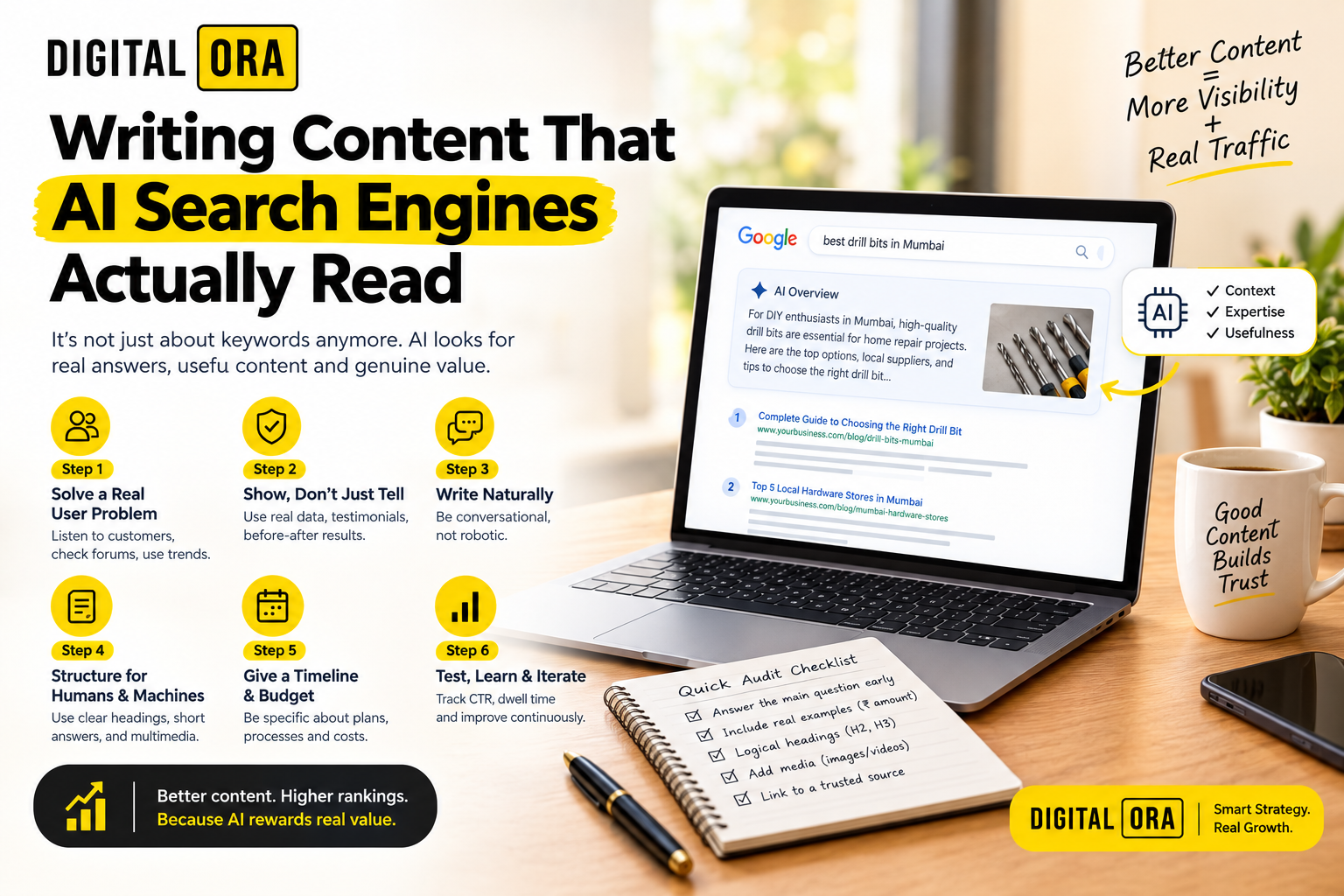
Writing Content That AI Search Engines Actually Read
Why the usual SEO checklist is failing your AI‑driven search traffic
Ever asked yourself why a well‑optimized product page for your Bandra boutique still shows up on page three of Google while a competitor’s simple blog post lands on the first page? The answer isn’t a missing keyword; it’s that the search engine now reads content through an AI model that cares about context, expertise, and usefulness.
Step 1: Start with a real user problem, not a keyword list
When a Thane hardware store owner asked us to boost traffic for "best drill bits," we stopped chasing that exact phrase. Instead, we asked: "What stops a DIY enthusiast in Mumbai from finishing a home repair project?" The resulting article answered the question, listed affordable local suppliers, and even added a short video showing how to choose the right bit. Within six weeks, the page saw a 40% lift in organic visits.
How to find the problem
- Listen to your sales team – they hear the objections daily.
- Check WhatsApp groups or local forums for recurring questions.
- Use Google Trends for city‑level spikes – e.g., "rain water harvesting" spiked in July in Mumbai.
Step 2: Show, don’t just tell – embed tangible proof
AI models evaluate the depth of your content. A claim like "our service saves you money" is vague. Instead, write something like "our average client in Andheri saves ₹12,000 per year on electricity after installing our LED retrofit, based on 18 months of meter data." That concrete figure makes the paragraph stand out to the AI and to the reader.
What counts as proof?
- Customer testimonials with names and locations (e.g., "Ramesh, Borivali, 2022").
- Simple before‑and‑after tables – cost, time, result.
- Short video clips or infographics – embed them, don’t just describe.
Step 3: Keep the language natural – write for a friend over chai
If you imagine explaining your service to a neighbour at a street‑side tea stall, you’ll avoid the robotic tone that AI models flag as low‑value. Use short punchy sentences like "You need a plumber now. Call us, we’re on the next lane." Mix them with a longer sentence that gives context, such as "Our team arrives within 30 minutes because we’ve mapped every alley in South Mumbai, so you won’t wait for an hour while traffic snarls on the Western Expressway."
Common mistake: over‑optimising for exact matches
We saw a Pune gym that peppered every paragraph with the phrase "best fitness centre in Pune" to satisfy a perceived SEO need. The AI model recognised the repetition, downgraded the page for keyword stuffing, and traffic nosedived. The fix? Replace the phrase with natural synonyms and focus on the user's intent – "where to get a personal trainer near Kothrud".
Step 4: Structure for both humans and machines
Headers act like road signs for AI. Use h2 for major topics and h3 for sub‑points. Inside each section, start with a brief answer, then expand. This mirrors how the AI extracts concise snippets for featured snippets.
Example outline for a bakery
What makes a perfect sourdough starter in Mumbai's climate?
Ingredients you can buy at Crawford Market
Timing – why 12‑hour feeds work better during monsoon
Common pitfalls and how to fix them
Step 5: Give the AI a timeline and a budget – it loves specifics
When we helped a Dharavi textile shop revamp its product descriptions, we set a clear plan: three weeks for research, two weeks for drafting, and a fortnight for review. The total spend was ₹18,000 for copywriting and a ₹5,000 boost for schema markup. By the end of month two, the shop’s organic sales grew by roughly 25%.
Why timelines matter
AI models infer credibility from structured processes. Mentioning a realistic timeframe (e.g., "we typically see ranking improvements in 8‑12 weeks") signals that you’ve tested the method, not just theorised it.
Step 6: Test, learn, and iterate
After publishing, monitor two metrics: click‑through rate (CTR) on the SERP and average time on page. If the CTR is low, rewrite the meta title to be more answer‑focused. If dwell time drops, add a FAQ accordion that addresses secondary questions – AI sees the added depth as valuable.
Quick audit checklist
- Is the primary question answered within the first 100 words?
- Do you have at least one real‑world example with a rupee figure?
- Are headings logical and hierarchical?
- Is there multimedia that supports the text?
- Have you linked to a reputable source or your own case study?
Takeaway you can act on today
Pick one piece of existing content on your site, find a concrete user problem it can solve, add a real example with a rupee amount, and restructure the headings. Publish the revised version and watch the AI model start to treat it as higher‑quality – you’ll see the first signs within a week.
Related Reading
Share this article
Grow Your Mumbai Business Online
Get a free ₹15,000 digital marketing audit.
No commitment. Results guaranteed.